By Dirk E. Huttenbach
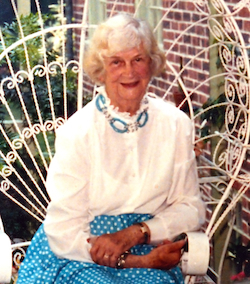 My mother, Berte Huttenbach, died on June 6, 1992, at home, in her own bed. She had a massive stroke. She was 82 years of age. I was her healthcare agent, appointed by her, many years before.
She died in Springfield, Penn, outside Philadelphia. I live in Sandy Springs, Ga. My sister lives in Germany. My mother had been in failing health following a minor stroke nine months earlier, in September 1991. She had a live-in caretaker, a good Christian lady, for those nine months, who looked after her very well.
Time and time again, my mother had reminded me that in the event of her having a major cardiac event or a major stroke, she absolutely did not want to go to a hospital or a nursing home. She reminded me. She badgered me. Constantly. She badgered her personal physician, too.
On June 6, 1992, around 10:00 a.m., after reading her morning newspaper, she had a major stroke. She was unconscious and could not speak. Her right side was paralyzed.
Her caregiver informed me by telephone. With a clear conscience, I could instruct her caretaker to move my mother from her living room chair to her bed in her bedroom. I told her caretaker to keep my mother comfortable. I would fly to Philadelphia as soon as possible and make further decisions.
My mother died before I made it to her house. She died in her own bed, in her own home, able to look at pictures of her loved ones placed all around her.
I was very grateful that she was able to die in peace, in comfortable, familiar surroundings, with a compassionate and competent caretaker looking after her.
My mother and I had already said goodbye a number of times before. My sister and I had discussed this possible scenario many times already. My sister and I were in full agreement in regards to this choice. I have heard, seen and experienced many other situations, however, where the end of life did not play out so well.
During my junior medical school clerkship at the Syracuse, N.Y. Veterans Administration Hospital 50 years ago, I was assigned to look after an aging U.S. World War I veteran. I was only 25 years old at the time. I was to follow my patient’s progress over six weeks. He was chronically ill, but mentally alert. He strongly told me two or three times: ‘Don’t have me become a vegetable like so many of these other fellows on our unit!†I agreed. What else could I say? What did I know?
Two weeks later, while making ward rounds with the attending resident, I noticed that my patient had stopped breathing. I rushed over. I checked his heartbeat. No heartbeat!
I panicked. I started pounding his chest. Lo and behold, he came back to life, except, he now was “a vegetable.†He remained in that state for the remainder of my clerkship rotation. I felt terrible. I felt I had violated his wishes. I did violate his wishes. I had to look at him daily, for four more long weeks. I am not proud of what I did.
A dear aunt of mine died in a nursing home, years later after a severe stroke. She was in her 80s. She remained in a vegetative state for the year or two following the stroke. A once vibrant, engaging, cultured woman, she became a shriveled up breathing corpse, staring into space, equipped with IV’s, a nasogastric tube, a catheter and a diaper. She no longer was able to communicate with anyone. She was unable to complain of any pain or suffering.
To my knowledge, there was no Advance Directive or Living Will. There was disagreement among immediate family members. My mother knew her well. She thought all this was terrible. My mother absolutely did not want this to happen to her. I am pleased and proud that this did not happen to her.
A time comes for all of us when we need to allow God (or Mother Nature, for non-believers) to take over. At that time, I believe medicine should shift from aggressive, futile medical care to comfort care, i.e., palliative care and/or hospice care, which is now much more available. Modern medicine can postpone death, but it cannot prevent death. Too much aggressive medicine can cause pain and suffering. Comfort care, in contrast, provides comfort.
Having an Advance Directive to express your wishes regarding end-of-life medical care is so important. The more people who know what you want, the more likely you will get the care that you want. It is very, very important not to leave your loved ones guessing and/or in conflict with each other over what you might or might not have wanted. A clear message from you, via a written legal Advance Directive, can make life so much better and easier for you, your loved ones, your physician(s) and your nurses.
An important part of your Advance Directive is to appoint a health care agent, who can and will speak for you when you can no longer speak for yourself. Your health care agent should be very informed regarding your wishes. He or she needs to carry out your wishes, even if family members or medical personnel raise questions or disagree. It is therefore also very important for you to keep your immediate family, your medical doctors and your nurses well informed. You do not want significant others to disagree with your Advance Directive wishes or with your health care agent.
There are people who want their physician(s) to prolong the lives of their dying relatives as long as possible. They want the physician “to do everything.†They want to do this out of love, out of religious beliefs, but sometimes out of denial or guilt. Their hopes and wishes need to be respected, but they should also have the opportunity to hear from physicians and nurses. They need to hear that “everything in medicine†is not necessarily “the best of medicine.â€
I believe that the best that medicine can offer at the end of life is comfort care, i.e., palliative and/or hospice care, as directed via one’s Advance Directive. Increasingly, I hope and believe, this is becoming the accepted standard of care. It makes for much less pain, suffering and conflict at a time that is difficult already.
Because of my own experiences, and because of hearing and reading stories from and about so many other people, patients and parents of patients, I felt a need to become more involved, even though my regular job is being a child and adolescent psychiatrist.
I served on the Kennestone Hospital Ethics Committee for a number of years under Richard Cohen, M.D. I joined the citizen organization Compassion and Choices (C&C), which promotes comfort care at the end of life. I have served on the Board of Directors of the C&C Georgia Chapter for about eight years. Our Georgia C&C chapter’s main mission is to educate the Georgia public on the need to prepare their Advance Directive sooner, not later.
I have advocated for Patient Proposed Physician Orders (PPPO) to facilitate that initial discussion between patients and their physician(s). This idea was approved and supported by the Cobb County Medical Society and is available via the Cobb County Medical Society website at www.cobbdoctors.org. I have also advocated for Advance Directives at Medical Association of Georgia House of Delegates meetings.
I now offer the opportunity for people to back up their legal written Advance Directive with a personal video recording, described more fully later in this article.
I signed my own first Advance Directive in April 2005, about a week after the death of Terry Schiavo. I had prepared it earlier but had not signed it until then. I, like many others, procrastinated, even though I strongly believed in the cause of Advance Directives.
I recently revised my Advance Directive to have it conform to the State of Georgia recommended Advance Directive format, created by the Georgia Legislature in 2007 as part of HB-24. This was beautiful, much-needed bipartisan legislation sponsored by Representatives Steve “Thunder†Tumlin (38th District), Mike Keown (173rd District), Allen Freeman (140th District), Mary Margaret Oliver (82nd District), and Katie Dempsey (13th District), and signed by Governor Sonny Purdue. Anyone can download this model Advance Directive, fill it out, and use it for their own Advance Directive.
I gave my updated (paper) Advance Directive to my son and health care agent, Eric, 40, over Thanksgiving 2013. He prepared electronic copies, which he then emailed to me, my wife, his brother and his two sisters. He pointed out that having my Advance Directive in electronic form makes it available on his smartphone. This way, he told me, he can access my Advance Directive anytime he wants to or needs to. I thought that was very smart. It makes my Advance Directive much more available to those who need to know.
How do you keep your loved ones well informed?
1. Talk to them. Talk to them repeatedly about your wishes. Have that    conversation. My mother did so. I have done so with my wife, my children and my personal physician.
2. Prepare your own legal written Advance Directive, which includes appointing your health care agent. It is wise to appoint a back-up health care agent. Give a copy of your Advance Directive to your health care agent. Give copies to your immediate family, other loved ones, as well as your personal physician. Do it or have it done electronically also. Give it to anyone who should be informed about you. Hospitals are now starting to keep that kind of information in their records regarding you, which is very good. Review your Advance Directive, preferably every five years. Your circumstances and/or preferences may change over time.
3. To express your views even more strongly and clearly, you can have a digital video recording made of you discussing your Advance Directive with a knowledgeable professional, such as myself. The idea of making this available grew in my mind over the years, subsequent to my mother’s death. The idea also grew as I grew older myself. I felt it was important to have one’s expressed wishes to be as clear, as available and as people-friendly as possible.
Having an Advance Directive video backup can make it easier to have a constructive discussion with those you want to inform. “A picture is worth a thousand words.†It is also helpful to have these video comments available, in addition to your legal written Advance Directive, if you are no longer able to speak on your own. This can be very supportive to your health care agent, especially if he/she has to face people who question or disagree with your wishes.
It is good for your loved ones to hear and see your words come out of your mouth while you are still mentally competent. You will support and back up your legal written Advance Directive with your own words on your personal video. Even though your written legal Advance Directive conveys your wishes already, your wishes expressed by you on a personal video will feel more personal and may better convince those who need to know and respect your wishes.
Admittedly, a personal video makes for added expense. Obtaining the Georgia Advance Directive for Healthcare format can be done for free, via a download from www.aging.dhr.georgia.gov. A personal video is more personal, however. You can direct comments to loved ones. Video clients have done so already.
Information about the Advance Directive Personal Video is available at www.advancedirectivesvideo.com, which includes three demonstration videos. The individuals featured have graciously and joyously given consent to allow their interviews to be used to inform the public.
In conclusion, most importantly:
1. Start that conversation with your loved ones and your physician.
2. Prepare your written legal Advance Directive. Do it sooner rather than later. Do not wait until it is too late.
3. Be nice to yourself, your loved ones, your physician and your nurses. Do not leave them guessing at a time when they need to know what you want. Make yourself as clear as possible.
Dirk E. Huttenbach, M.D., DLFAPA, lives in Sandy Springs and has been in private psychiatric practice in Cobb County since 1972. He is Board Certified in general and child psychiatry. He belongs to the Cobb County Medical Society, MAG, AMA, APA and the Georgia Psychiatric Physicians’ Association (GPPA). He is a Distinguished Life Fellow of the American Psychiatric Association. He was GPPA Georgia Psychiatrist of the Year in 2003. Â


