Cardiovascular disease (CVD) is the leading cause of maternal mortality in the United States, which has the highest infant and maternal mortality rates of any other high-income country. Georgia, in particular, has some of the worst maternal outcomes in the country (See Figure 1).
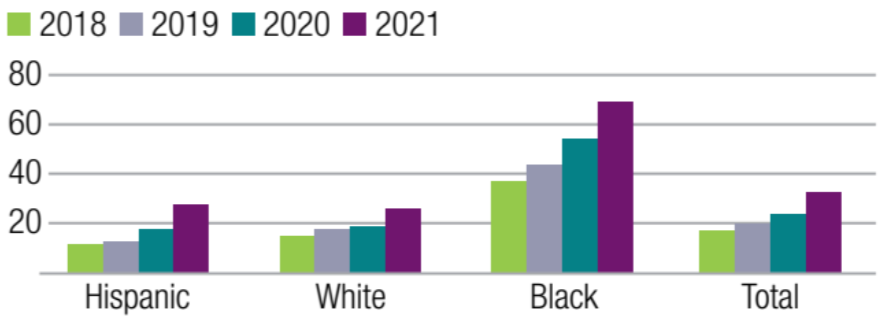
The Georgia Department of Public Health’s latest Maternal Mortality Report found 35.7 pregnancy-related deaths per 100,000 live births between 2019 and 2021, which is up from 30.2 deaths between 2018 and 2020. The 2018-2020 report also highlighted that the rate for Black women was more than twice as high as for White women, which reflects national trends seen in the CDC’s National Center for Health Statistics (See Figure 2). Similarly, somber news was published in a JAMA report last year that showed nationwide maternal mortality rates more than doubled between 1999 and 2019. Georgia was among the five worst states for increasing mortality among White, Hispanic, Black and Asian Pacific Islander women.
Perhaps most shocking and distressing of all the data presented was that the great majority of deaths amongst women, nearly 85% according to the most recent Georgia Maternal Mortality Report, were preventable.
Several of our state’s leaders, including Sen. Raphael Warnock, Georgia Department of Public Health Commissioner Dr. Kathleen Toomey and Medical Association of Georgia President Dr. Charles Wilmer, have all sounded the alarm about this topic and spoken out about the great challenge we face in our state to reduce maternal mortality.
What can we do individually, as a group of medical professionals, and at the public health and policy levels to address this problem?
Figure 1
The U.S. has the highest rate of infant and maternal deaths
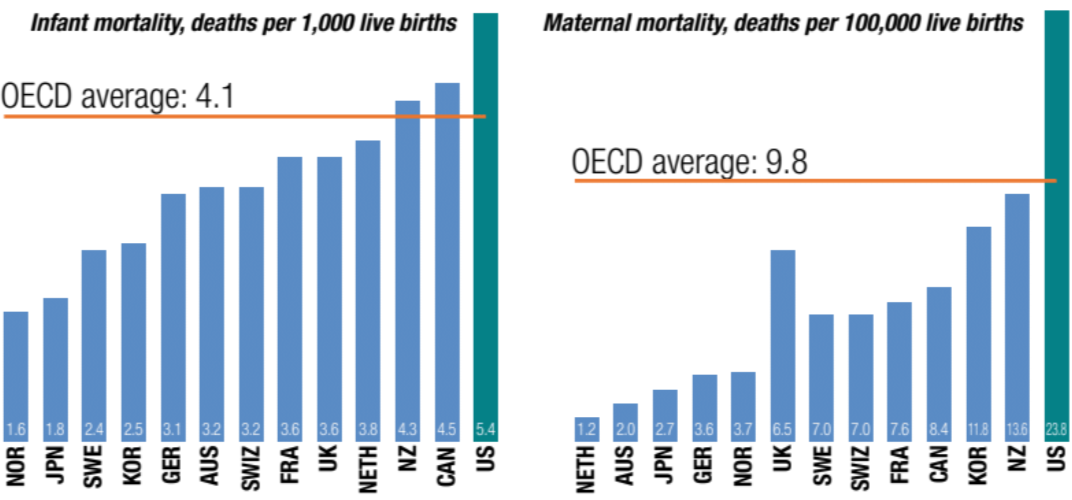
Figure 2
Maternal mortality rate among Black women was more than double the average
Build Strong Cardio-Obstetric Teams & Focus on Cardiovascular Disease
The rise in maternal morbidity and mortality has been of particular importance to those of us who practice cardiology because CVD is the leading cause of pregnancy-related deaths. There are a number of explanations for these trends: women are now older, have more cardiovascular (CV) risk factors and have more complex cardiac disease at the time of their first birth. In response to this, calls for cardio-obstetric models of care have emerged from major healthcare organizations including the American Heart Association and the American College of Cardiology.
A cardio-obstetric model of care involves clinicians from multiple subspecialties and will vary based on the complexity of the patient’s underlying cardiac condition. Team members may include professionals in obstetrics, maternal fetal medicine (MFM), primary care, cardiovascular medicine, cardio-obstetrics, anesthesiology, nursing, pharmacy and social work.
This type of multi-disciplinary collaboration is key to successful management of women with CVD pursuing pregnancy and even for women without CVD but with CV risk factors like chronic or gestational hypertensive disorders. Indeed, coordinated cardio-obstetrics teams have been shown to decrease adverse cardiac complications during pregnancy. The cardio-obstetric team focuses on delivering care to pregnant patients from preconception through the postpartum period.
It is especially important to note that postpartum care is a critical component of this model because it is at this time that women are at especially high risk for experiencing CV pregnancy-related complications. Over 70% of maternal deaths occur postpartum and nearly 40% occur within the first 6 weeks.
Ideally, all major healthcare institutions across the state would have cardio-obstetric teams available to care for pregnant patients. We are fortunate that at our institution, the Piedmont Heart Institute in Atlanta, we have multiple cardio-obstetric experts, access to a large tertiary care hospital with multiple cardiac subspecialties, and a robust partnership with our obstetric and MFM colleagues. We recommend that all pregnant patients with or at high risk for the development of CVD be cared for by a cardio-obstetric team. We recognize that not all communities across the state have the infrastructure to develop or maintain cardio-obstetric teams, and we recommend that physicians in those communities refer patients to centers that have these capabilities.
Lastly, we strongly believe that innovation in healthcare delivery is paramount to providing high-quality cardio-obstetric care. Approximately 40% of women do not attend postpartum visits, citing stress, fatigue, adjustments to caring for a newborn, lack of social support, finances, transportation or language as major barriers. We recommend all cardio-obstetric teams have access to telemedicine visits and consider other digital health-based technologies to increase access for patients.
Table 1
| Support for Ongion Internventions | Recommendations |
| Continue to build cardio-obstetric programs across the state in centers that have the resources and expertise to care for these high-risk patients | Refer to cardio-obstetric programs. If not available in patient’s community, refer these high-risk patients to tertiary care centers with existing cardio-obstetric program |
| Innovation in healthcare delivery | Focus on building telehealth, digital-based healthcare technologies to improve access to care |
| Medicaid coverage expansion for new mothers for a full year after giving birth | Medicaid expansion to women who are considered at high risk before pregnancy. Expanded access to contraception |
| Pilot program – visiting new mothers at home | Bias Training/Mitigation strategies available for all healthcare providers in the state |
| Focus on healthcare workforce diversification | |
| Funding from legislators to address Social Determinants of Health |
Support Public Health and Policy Interventions
We support the bill that Governor Kemp signed into law last year that expands Medicaid coverage to new mothers living on low incomes for a full year after they give birth. New mothers in Georgia were previously covered for 6 months.
The Medicaid and CHIP (Children’s Health Insurance Program) Payment and Access Commission reported previously that Medicaid expansion has reduced both maternal and infant mortality. As we stated previously, the postpartum period is critical for care, and it is our hope that expansion of care for the year after delivery will help reduce late maternal deaths.
We additionally recommend that during this time, Medicaid expansion be used to facilitate interpregnancy cardiovascular screening and risk factor optimization and to increase access to contraception. Access to contraception can be challenging for patients for many reasons, but financial and insurance coverage are major barriers. Reducing out-of-pocket costs for contraception is associated with improved patterns of use and reducing unintended pregnancy rates, and it has also been shown to reduce healthcare costs.
We furthermore recommend that legislators consider Medicaid expansion to women who are considered high risk before pregnancy. Pre-pregnancy counseling and early pregnancy interventions have been shown to reduce adverse pregnancy outcomes.
The Georgia Department of Public Health is also piloting a program to visit new mothers at home during pregnancy and for the first year after birth. The initial phase of the program will focus on rural counties in northeast and southeast Georgia. We support this program and recommend others like it, as these are communities that have limited access to pre- and postnatal care.
Addressing Racism and Social Determinants of Health
In every year of the JAMA study, maternal death risk across states was highest in Black women. Georgia was no exception – over 50% of deaths were in Black women, 34% were among White women and 7% were among Hispanic women. The report also found that 15% of maternal deaths nationally were related to bias and discrimination. All of this data indicates that despite current prevention efforts, risk of maternal death, especially for Black women, has not decreased.
We recommend additional investigations to better understand what factors are specifically contributing to maternal mortality in this population in our state. Factors like poverty, racism, geography, education, medical literacy and access to healthcare insurance are known to contribute to disparities in CV health outcomes in women. Many recommendations have already been outlined in our comments above, but we additionally recommend that bias training/mitigation strategies be made available to all healthcare providers in the state. We need to focus on healthcare workforce diversification across educational institutions and workplaces and on strengthening our partnerships with existing community resources, and we encourage funding from legislators to support these programs.
We believe that mothers are the backbone for any family. No child should ever grow up without their mother. Reducing maternal mortality becomes even more critical when we recognize the many single-parent households in the state.
Young children and growing families of Georgia depend on the health and continued well-being of their mothers. Our team is committed to reducing adverse cardiac outcomes in women across the state and we implore our colleagues to join us in this endeavor.
References
1. Petrullo J. US has the highest infant and maternal mortality rates despite the most health care spending. AJMC. January 31, 2023. Accessed February 25, 2024.https://www.ajmc.com/view/us-has-highest-infant-maternal-mortality-rates-despite-the-most-health-care-spending
2. Fleszar LG, Bryant AS, Johnson CO, et al. Trends in State-Level Maternal Mortality by Racial and Ethnic Group in the United States. JAMA. 2023;330(1):52–61.doi:10.1001/jama.2023.9043
3. Georgia Department of Public Health. Maternal Mortality Report. Accessed February 25, 2024.https://drive.google.com/file/d/12rtkpP4XdaCL5rk4Z1ovYPGXfFLSNzSd/view
4. Davis MB, Arendt K, Bello NA, et al. Team-Based Care of Women with Cardiovascular Disease From Pre-Conception Through Pregnancy and Postpartum. JACC. 2021;77 (14): 1763-1777.5. Lindley KJ, Aggarwal NR, Briller JE, et al. Socioeconomic Determinants of Health and Cardiovascular Outcomes in Women. JACC. 2021; 78 (19): 1919-1929.
 Dr. Jyoti Sharma
Dr. Sharma graduated from Emory University School of Medicine. She completed her internal medicine residency at Beth Israel Medical Center and subsequently completed her fellowship in cardiovascular diseases at the University of Texas Health Science Center. She has been the Director of the Women’s Heart Program for Piedmont Healthcare since 2017 and is currently the Medical Director of Piedmont Atlanta Hospital, where she leads the strategic and operational work of physicians across multiple cardiac subspecialties. Dr. Sharma is the President of Piedmont Atlanta Hospital’s 2,200-member medical staff.
 Dr. Sara Mobasseri
Dr. Mobasseri earned her undergraduate degree from Washington University and her medical degree from the Medical College of Ohio. She completed her internal medicine internship, residency and cardiology fellowship at Rush University Medical Center. Dr. Mobasseri is board certified in internal medicine and cardiovascular disease and is certified in nuclear cardiology and adult echocardiography. Dr. Mobasseri currently leads the women’s heart program at Piedmont Heart and also serves as the associate director of echocardiology.


