Recognizing overuse injuries for specific sports
 The way sports are played in the United States has changed dramatically over the course of the last several decades. In the past, children and adolescents often changed from one sport to another as the seasons changed. However, recent trends reveal that kids are starting to specialize in a single sport at earlier ages, often playing and training over eight months a year.
With these changes, the type of injuries seen in youth athletes has also shifted. Acute injures have given way to overuse injuries as children are no longer able to strengthen different sets of muscles during different sports. Instead, they endure the same stressful loads year round, leading to a higher risk of injury. The likelihood of an overuse injury increases dramatically when young athletes participate in the same sport for more hours each week than they are years old.
While clinicians have been trained to identify and treat acute injuries, the presentation of overuse injuries to clinic can be more challenging as each sport has a unique set of overuse injuries. For example, the chief complaint of wrist or back pain when related to overuse has a different diagnosis depending on which sport is played.
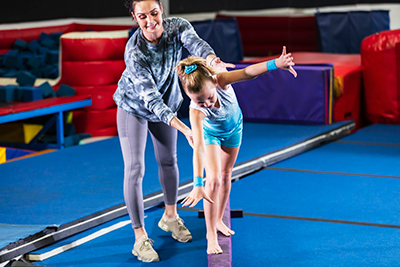
While athletes across all sports are starting to transition to single-sport specialization, high-level gymnasts have long been required to specialize at a young age. Many spend well over 16 hours per week performing rigorous and demanding physical movements. With these long hours and high loads, gymnasts are particularly susceptible to several overuse injuries, including spondylolysis and cartilage injuries to the elbow. Here, I will focus on one that is unique to tumblers: gymnast’s wrist.
What is gymnast’s wrist?
Gymnast’s wrist, or distal radius epiphysitis, is a unique overuse injury often seen in young gymnasts due to the repetitive high-impact stresses put on the wrist during tumbling and vaulting. These repetitive, compressive stresses cause irritation and inflammation to the growth plate at the end of the radius. Growth plates are often the site of injury in children and adolescents as they are made of cartilage, which is softer and weaker than the mature bone or ligaments around them.
Studies have shown that up to 88% of young gymnasts complain of wrist pain, with nearly half complaining of pain that lasts more than six months. If identified early, gymnast’s wrist responds wonderfully to non-operative treatment. If there is a significant delay to treatment, it often requires lengthy immobilization, physical therapy or occasionally surgical intervention.
How does gymnast’s wrist occur?
Unlike other athletes, gymnasts bear weight on their upper extremities and can transmit up to 16 times their body weight through their wrists during tumbling and vaulting. These repetitive, compressive, high-impact stresses cause microtrauma to the radial growth plate, which is weaker and at a higher risk of injury than the mature bone around it. This persistent inflammation eventually damages the growth plate and, when chronic, can be seen on X-rays as irregular bone edges, scarring or widening at the radial growth plate.
Occasionally, gymnast’s wrist can lead to premature closure of the radial growth plate, causing the radius to be shorter than the ulna. This asymmetry in length of the two forearm bones results in uneven stress distribution at the wrist with impact activities, leading to chronic pain, stiffness and difficulty competing in gymnastics or other daily activities.
What are the symptoms of gymnast’s wrist?
Patients experiencing gymnast’s wrist will feel pain, often described as aching, at the top of the wrist when they do an impact activity like tumbling. The pain typically appears gradually over a few weeks or months, and tends to start when the patient has recently increased the volume or intensity of training, or is trying a new activity. Initially, pain is described only during or after gymnastics, but eventually starts to bother the patient during everyday life.
On examination, there is usually mild tenderness over the radial growth plate. Occasionally, the patient also has mild swelling and reduced range of motion of the wrist, particularly with extension.
When caught early, diagnosis is based on the patient’s history and physical examination as changes to the radial physics will not appear on X-ray at this stage. Eventually, however, wrist X-rays will reveal widening or irregularity of the growth plate, signs of early closure involving a bony bridge across the growth plate or signs that the ulna is longer than the radius. Occasionally, when the diagnosis is unclear or if the condition does not improve, an MRI may be helpful to get a clearer picture of the long-term changes to the growth plate.
How is gymnast’s wrist treated?
Rest. This is often extremely frustrating to the athlete, but removing the stress to the growth plate over an extended period allows it time to heal and remodel. Initially, the condition is treated by putting the wrist into a brace or cast and then having the gymnast avoid impact activities such as tumbling for three to six months.
The athlete should also focus on strengthening the shoulders, arms, hips and core since changes to the body during skeletal growth often affect muscular strength. This can help reduce the force on the wrist and lower the risk of recurrence.
When the symptoms fully resolve, a slow and stepwise return to tumbling volume may be helpful.
What are strategies to prevent gymnast’s wrist?
Prevention is key to protecting athletes from overuse injuries. It is beneficial to have discussions with gymnasts and their parents about common overuse injuries, when they can occur and what to watch for. With gymnast’s wrist, several prevention strategies have proven helpful to reduce the risk of injury:
• Maintain appropriate strength and range of motion.
• As children grow, their muscles and bones do not always grow at the same time, and they can often lose strength they once had.
• Growing gymnasts should maintain range of motion and shoulder strength to reduce loads on the wrist and prevent injury. It may be helpful to work with a physical therapist.
• Use proper technique.
• Rest and recover.
• Gymnasts undergo a high volume of training and sustain recurrent high loads to their bodies during practice. It is important to take time for the body to recover and focus on maintaining good nutrition, getting good sleep and avoiding overuse. Gymnasts should listen to their body, avoid tumbling if painful and spread out high-impact activities with days of rest between them.
• Use devices to offload the wrist, such as Tiger Paws. This reduces both hyperextension and loads on the wrist.
As more youth athletes move to single-sport specialization, it is important to realize that many of the injuries that present to a physician are due to overuse rather than acute injuries. Understanding which injuries are most likely for children to sustain based on the individual sport can help prevent and treat these injuries.
 Steven Schulenborg, MD
Dr. Schulenborg is a pediatric sports medicine physician treating sports-related medical issues and injuries. Dr. Schulenborg holds board certifications in both pediatrics and sports medicine, and completed his medical degree and residency at the University of Tennessee Health Science Center. He completed his pediatric sports medicine fellowship training at Orlando Health, providing care for area schools and sports teams including the Orlando City Soccer Club. He currently provides sideline coverage for several Metro Atlanta high schools.


