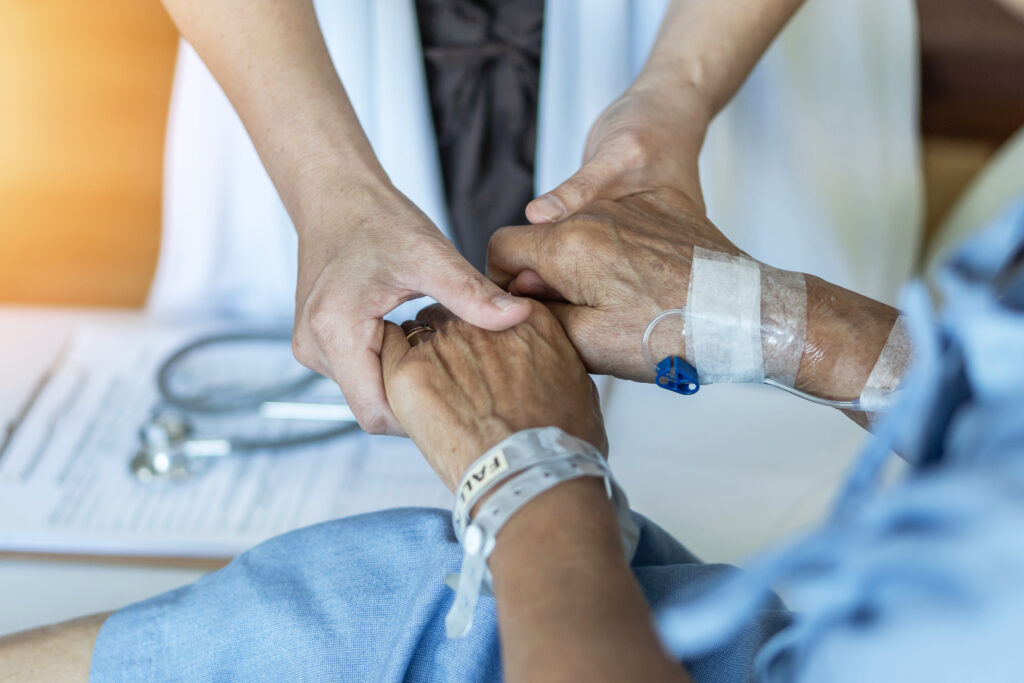
On my first day of a palliative care rotation as a medical student, I entered the hospital brimming with emotions – anxiety regarding what I had anticipated, curiosity regarding what I had never seen, and an immense amount of hope for the patients I would encounter. Guided by the attending physician, our rounds primarily focused on pain and anxiety management. This proved to be surprisingly less grim than I had expected, until our final patient of the day: a stroke case that warranted a discussion of code status with the patient’s family.
As we entered the room, the patient’s husband quickly rose to his feet, seemingly eager for solutions, answers or perhaps a miracle. Beside him lay his elderly wife, intubated and reliant upon him as her healthcare proxy. The physician introduced us and began discussing the patient’s poor prognosis while answering her husband’s questions.
“I’m here to discuss your wife’s code status,” the physician continued, delving into the implications of various options. I stood motionless, struck by the gravity of the physician’s words. “Chest compressions can be very traumatic; they would likely break several of her ribs,” the physician explained. It was the first time I had witnessed such a conversation, and with each sentence the room grew heavier and heavier.
Visibly distraught, the patient’s husband expressed the need for more time to make such difficult decisions. “Of course,” the physician replied. “We’ll be back tomorrow, but please take all the time you need.” I attempted to offer a comforting smile that felt misplaced as I nodded goodbye to the patient’s husband. He seemed uneasy and reluctant to conclude the conversation, despite a lack of further questions or comments.
I knew I was to follow the physician, who shared some final thoughts outside of the patient’s room before we parted ways. As I walked down the corridor, my pace began to slow. “I can’t just leave him like that,” I thought to myself before nervously turning back.
Upon re-entering the room, I found the patient’s husband sitting tearfully with his head bowed. As he looked up to meet my gaze, I managed to utter something along the lines of, “I just wanted to make sure you were okay. I’m so sorry you are having to make these decisions.”
His shock was evident, but after a brief pause he invited me to sit with him. In that moment, what he needed most was to discuss his wife in a completely different light than our previous conversation. I listened intently as he recounted the story of how they met, the immense happiness they shared over 60 years of marriage, and the depth of his adoration for her.
His devastation regarding her current state was palpable; I knew all I could offer was to sit and support him through it, even if only to temporarily alleviate a fraction of his pain. We shared tears and laughter together as he reminisced about cherished memories of his wife. I expressed my appreciation of all that he had shared with me before conveying how lovely his wife sounded one last time. As I stood to exit the room, he left me with words that I will carry into my career and beyond: “Thank you for not being a robot.”
As a medical student, expectations of professionalism often lead to restrictions regarding how to interact with patients or their families. You’re not supposed to develop close or friendly relationships. You’re not supposed to go off script. You’re definitely not supposed to cry or show emotion. I have always struggled to reconcile these “rules” with my own sense of humanity. Despite the ultimate goal of providing optimal, individualized patient care, why do we often ignore what the patient or their family need most in a given moment? Do we really believe that memorized, template responses carry as much weight as a response specific to the situation, the setting, or the human being in front of us?
I firmly believe otherwise, as true patient care transcends these generalized responses and demands emotional intelligence. It is paramount that physicians are able to successfully “read the room” and offer genuine condolences to assist someone through a difficult time rather than scripted lines. Simultaneously, not every patient finds solace in sharing emotions or vulnerability with their physician.
Emotional intelligence involves the ability to discern and authentically respond to individual needs, and there is profound irony in the fact that a skill so fundamental to an exceptional physician is often difficult, if not impossible, to teach. It is an art, not a science, that requires more from the heart than the head.
In my opinion, this is far more important than the ability to quickly recognize a disease presentation or recite the correct dosing of an antibiotic. After all, these technical competencies become insignificant if you cannot build meaningful connections with your patients and show that you are as human as they are.
The patient-physician relationship, while unique, is just that, a relationship. Relationships are built on trust, understanding and genuine compassion. How am I to prove to patients that I am capable of this without showing emotion or personality?
I am not a robot, and I refuse to abide by these “rules” of medicine or their rigid constraints. I left that rotation understanding the value of such an approach, eager to touch the lives of as many patients as possible in a way that might truly impact them. While certain conversations may never become any easier, I suppose that is also the goal: to never become desensitized to patient difficulties and to always demonstrate that I am not a robot, but rather a human being, too.
Counseling of the patient, like any skill, develops over time. During the process, the physicians also learn the extent to which they could be involved with the patient care, within boundaries. For example, with oncology and psychiatric patients, one cannot get to the same level. Excessive involvement with patients would cause emotional instability of the physicians and could be self destructive. After all, they, too, are humans and not robots!
 Dr. Lopez attended the Medical College of Georgia and will be starting her internal medicine residency at the University of Miami at Holy Cross Hospital. She plans to pursue a career in primary care.


