In 1971, the INTERNIST-1 expert medical system was developed by researchers at the University of Pittsburgh. The system could analyze thousands of symptoms and signs across hundreds of diseases and make recommendations to physicians regarding diagnosis and treatment. This system was one of the early waves of computerized decision support systems in the 70s and 80s including such esoteric names as MYCIN, CADUCEUS, and QMR. These systems were innovative but extremely difficult to maintain with complex knowledgebases, time-consuming user interfaces requiring answering dozens of questions to make a diagnosis, and they ultimately fell by the wayside. These were visionary but impractical tools for daily practice.
In the 1990s and 2000s, clinical decision support tools moved into the domain of electronic health record (EHR) systems. Guidance for physicians was attempted through extensive alerts, reminders, pop-ups, and order sets to ensure that doctors were following best practice and avoiding errors. Unlike the earlier generation, these systems achieved widespread institutional adoption and some degree of commercial success for knowledge vendors. But they were widely viewed as a hindrance by physicians, who overrode automated recommendations at a rate of over 95%. Despite gradual improvement in these systems over the years, with attempts at improved user workflows and incorporation of machine learning algorithms to deliver more precision patient guidance, the overall level of physician tolerance for alerts remains low.
On a parallel track to decision support tools have been physician references, which have remained necessary and popular over the years. From the Merck Manual to Harrison’s to UpToDate, doctors have actively sought high quality, well-referenced resources for consultation. In particular, UpToDate has been dominant, commanding a price point of $600+ per provider per year, with many hospitals spending hundreds of thousands of dollars annually. Hospitals that sought to move to less expensive alternatives have often run into provider pushback and reversed their decision despite the high costs. But then something began to change. In 2023, UpToDate was seeing 5.63 million monthly visits. This number dropped to 2.67 million by June 2025, marking a 52% decline. While the cause of this drop cannot be definitely tied to the rise of AI tools, the temporal pattern is suggestive.
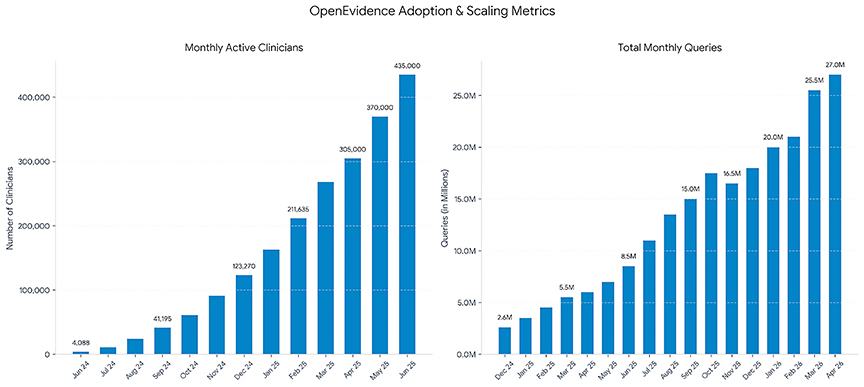
OpenEvidence is a chat-based medical reference tool that provides detailed, well-sourced recommendations for nearly every clinical domain. It is available free of charge to physicians with an NPI in the United States. OpenEvidence’s pace of adoption has been vertiginous to say the least. Below are graphs of monthly active clinicians and queries on the platform since 2024. Nearly two-thirds of physicians in the U.S. use OpenEvidence, with 95% of new users having been recommended to the platform by a colleague. So this growth has been driven almost entirely by word-of-mouth rather than institutional licensing or integration with the electronic health record.
The rapid rise of OpenEvidence reflects the convergence of two attributes that have often been at odds in the history of clinical decision support: convenience and trust. EHR-integrated systems are convenient, pulling patient data directly from the EHR, but their guidance has been mediocre at best. Resources like UpToDate are trustworthy, but mapping the patient context to the specific information to look up takes time, and the ability to explore personalized or follow-up questions is limited. With OpenEvidence, physicians can ask questions exactly in the manner that they think of them. They get answers back that are comprehensive, referenced, and amenable to follow-up and patient-specific nuance. In the coming year, it is expected the OpenEvidence will be integrated into EHRs such as Epic, bringing together rapid access to patient data with an established physician trust. This will mark the start of an era where physicians actively use and rely upon (perhaps over-rely upon) EHR recommendations for patient care.
So what comes next? The ability of AI to consume patient data efficiently will continue to improve, as will the ability to provide answers grounded in the literature and tailored to best practices as defined by local institutions and provider groups. These improvements will continue to build both the convenience and perceived trust in the quality of these systems. The economics, however, will change. Whether via institutional subscriptions, expanded advertising, or more active extraction of physician knowledge, AI tools such as OpenEvidence will need to convert their substantial popularity and use into equally substantial revenue. Looking further forward, we may expect more interesting developments, not only technically but economically, as health AI companies could begin offering some forms of virtual healthcare services or partner with a limited set of institutions. Certainly those health systems with the strongest AI tools may in the future attract the best physicians, bring in the most patients, and even command higher payments than their competitors.
For years, ‘expert systems’ have been something of an academic pursuit, showing great potential but often relegated to the role of nuisance by daily practitioners. We are now at the beginning of a massive inversion, where AI systems will become vital, essential partners in the delivery of healthcare. I have not explored the many downsides of this change, from physician deskilling to loss of human connection, but they are potentially profound. For now, however, it is important for providers to begin trying out these tools and seeing how they can use them to the benefit of themselves and their patients.
 Dr. Jon Duke is Regents’ Researcher and Director of the Center for Health Analytics and Informatics at the Georgia Tech Research Institute. Dr. Duke has led over $72 million in funded research for industry, government, and foundation partners, with applications spanning research, quality, public health, and clinical domains. Dr. Duke graduated from Harvard Medical School and completed his internal medicine residency at Brigham and Women’s Hospital.


