 By Helen Kelley
Hyperbaric oxygen therapy is medical treatment in which an ambient pressure greater than sea level atmospheric pressure is a necessary component. Best known for it use in treating scuba divers who are suffering from decompression sickness, it can also be used for treating other illnesses including serious infections and wounds that won’t heal. Atlanta Medicine spoke with two Atlanta physicians who delved into the many applications for hyperbaric oxygen therapy and exciting possibilities on the horizon for new treatment options.
Many avenues to be explored using hyperbaric oxygen
“The physiologic changes that hyperbaric oxygen can bring about have opened up numerous possibilities in the treatment of chronic medical conditions,†said David Schwegman, M.D., who is the medical director of Hyperbaric Physicians of Georgia and serves as Medical Director for HyperbaRXs at Northside Forsyth. “The high pressure environment and hyperoxygenation associated with this form of therapy can decrease inflammation and help cells fight infection, kill bacteria and create stem cells. It can be a powerful tool in the healing process.â€
Schwegman says that hyperbaric oxygen can be particularly helpful in treating diabetes, the long-term effects caused by radiation therapy and a variety of wounds.

“For diabetic patients, the disease has downstream consequences. Hyperbaric oxygen has long proved successful in helping heal foot wounds. But it’s also been shown to ‘trick’ the body into creating brand new blood vessels that have never been clogged with cholesterol or affected by blood sugar levels — these baby blood vessels can help the body heal itself, with lasting effects,†he explained.
He notes that most physicians have had little to no training in what hyperbaric medicine is, and therefore, can be dismissive of it. But he’d like the physician community to become better acquainted with the benefits of this growing area of medicine.
“When you look at hyperbaric medicine as an outsider, the premise does seem ridiculous — you’re breathing oxygen, which you do all the time anyway, so why would breathing more of it help heal anything?†Schwegman said. “However, what I would like for physicians to understand is that the physiologic changes that happen with hyperbaric treatment can bring about healing. For example, if they have a patient who has a bone infection that just won’t go away or they know that having more blood vessels would speed someone’s healing, an understanding of the benefits of hyperbaric oxygen therapy would be so helpful.â€
There is a growing potential for application of hyperbaric therapies, but it will take educating the physician community at large that this is an area with the ability to revolutionize medicine.
“Current research shows the possibilities of treating many illnesses and disorders with hyperbaric oxygen. One of those studies is focusing on the use of hyperbaric oxygen in combination with a ketogenic diet to treat or prevent certain types of cancer. Other research shows that hyperbaric oxygen therapy can improve erectile dysfunction,†Schwegman said. “There are wide-sweeping applications because of the widespread physiological changes in the body brought about by hyperbaric medicine. We’ve only scratched the surface.â€

Treatment for variety of injuries and diseases
Hyperbaric oxygen is increasingly being used as a treatment and rehabilitative therapy for a number of medical conditions, according to two physicians with HYOX Hyperbaric and Rehabilitative Medicine. Medical Director Richard W. King, Jr., M.D. and Marianne Taryla, M.D., say the therapy is successfully being used to treat things like post-concussive syndrome, avascular necrosis, side effects from cancer treatments and even infertility.
“I think some of the more interesting things that we’re using this therapy for now go beyond the agreed-upon treatments such as diabetic wound care,†said Dr. King. “For example, our military is studying the use of hyperbaric oxygen in treating patients who have post- concussive syndrome. This could have application on veterans returning from war, those suffering from post-traumatic stress disorder resulting from brain injuries and even athletes. Additionally, in other parts of the world, we are learning about patients with avascular necrosis who have received hyperbaric oxygen therapy and avoided surgery for joint replacement.â€
Dr. Taryla says that hyperbaric oxygen therapy is proving to be beneficial in the area of women’s health, as well.

“For women with breast cancer, there is now plastic surgery for partial mastectomy with nipple sparing. There is a 45% nonsuccess rate for this surgery, but with hyperbaric oxygen treatment after surgery, there is a success rate of 80- 90% for salvaging the nipple and areolar area,†she said. “In women who have fertility problems due to endometrial receptivity, hyperbaric oxygen can also be helpful in improving their ability to hold an egg by vascularizing the area.â€
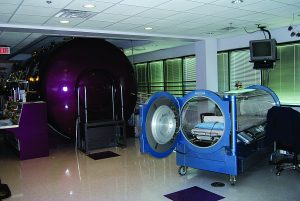
Advancing technology has improved the way patients receive hyperbaric oxygen therapy. Different configurations of hyperbaric chambers have different applications for delivering therapy to patients.
“The submarine chamber we use in our practice allows us to make this treatment available to patients who come in on a stretcher or in a wheelchair, while the multi-place chamber has room for up to 12 people to be treated at one time,†explained Dr. King. “The chambers have easy access and can accommodate patients who have special needs such as someone who has hypoglycemia that requires monitoring or is wearing a wound vac.â€
King encourages other physicians to become educated about the usefulness of hyperbaric oxygen therapy and to consider referring patients who can benefit from it.
“Hyperbaric medicine can be helpful in so many instances, such as faster healing of ligaments and tendons, recovery from after-effects of radiation treatment and curing wounds that just won’t go away,†he said. “The earlier a physician refers a patient for treatment is always better. It’s easier to treat the condition sooner than later, with likelier success.â€
Hyperbaric Medicine in the news
The Department of Defense-sponsored clinical trial on hyperbaric oxygen for mild traumatic brain injury has yielded promising findings for future research.
The Emmes Corporation of Rockville, Md., recently announced that scientists and health professionals from Emmes LDS Hospital in Salt Lake City, Ut., Lovelace Biomedical Environmental Research Institute in Albuquerque, N.M., and the U.S. Army Medical and Materiel Development Activity at Fort Detrick, Md. have completed a multiyear clinical trial testing hyperbaric oxygen as an intervention for U.S. military service members who have suffered mild traumatic brain injuries with persistent symptoms. The study included both active-duty soldiers and veterans in the military who suffered from mild traumatic brain injuries.
Millions of people in the United States deal with traumatic brain injuries, and combat military personnel have increased risk for persistent post-concussive symptoms. This clinical research studied military personnel with post-concussive symptoms occurring three months to five years after mild traumatic brain injury. The randomized clinical trial evaluated participants’ specific symptoms, as well as a range of other assessments such as quality of life, sleep, cognitive processing, as well as auditory, visual and neuro-imaging traits.
Hyperbaric oxygen produced short-term improvement in self-reported post-concussive and post-traumatic stress disorder (PTSD) symptoms, as well as some cognitive processing speed and sleep measures, in comparison to a control group. These improvements regressed after six months, however. One notable finding was that improvements were most significant in trial participants suffering from both traumatic brain injury and PTSD.
“We are planning to produce more in-depth papers on the findings of this study,†noted Dr. Steffanie Wilson, Emmes biostatistician and principal investigator of Emmes’ data analysis and management center for the research team. She added that additional research could address such issues as dosing, length of treatment and patient selection.
The paper was published in the March/April 2018 issue of the Undersea and Hyperbaric Medicine Journal.


