Will AI Take My Job?
That is the question many physicians are asking, even if not always out loud. We ask it in hallways, at conferences, during conversations about documentation burden, and sometimes quietly after seeing yet another demonstration of an AI tool that seems to write notes, answer clinical questions, interpret images, generate differential diagnoses, summarize records, and communicate with patients.
The question is understandable. Medicine has changed dramatically in the last two decades. Electronic health records transformed our daily work, but not always for the better. Documentation expanded. Inbox messages multiplied. Prior authorizations became a routine part of clinical care. Physicians now spend a large portion of their time doing work that feels only indirectly related to healing patients.
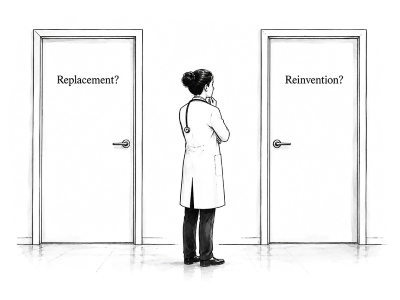
So when AI arrives with promises to document visits, code encounters, triage messages, read images, suggest diagnoses, monitor chronic disease, assist with medication requests, and even com
municate directly with patients, it is reasonable to ask: is this our friend or our enemy?
My answer is:
AI is neither. AI is a tool. More precisely, it is becoming part of the infrastructure of medical practice. Like the EHR, it will not remain optional for long. The important question is not whether AI will enter medicine. It already has. The important question is whether it will be implemented in a way that strengthens physicians and improves patient care, or in a way that adds another layer of complexity, surveillance, liability, and productivity pressure.
In the near term, AI is most likely to replace tasks, not physicians. Many of those tasks are the ones physicians dislike most: drafting notes, summarizing hospital courses, generating discharge instructions, preparing patient-friendly explanations of test results, searching large charts for relevant information, assisting with coding, and helping manage routine patient messages. Used well, these tools could return time and attention to the physician-patient relationship.
That would be a major advance. A cardiologist should not spend the best part of the day functioning as a data-entry clerk. A primary care physician should not end clinic with hours of unfinished documentation. A specialist should not have to search through dozens of pages of outside records to find the one sentence that changes management. If AI can reduce that burden safely, physicians should welcome it.
But The Story Is Not That Simple
Every efficiency tool in medicine eventually raises a second question: efficiency for whom? If AI allows clinicians to complete documentation faster, will that time be returned to patients and physicians, or will schedules simply become more crowded? If AI improves coding accuracy, will that benefit physicians and practices, or mainly health systems and payers? If AI reduces administrative work, will physicians experience less burnout, or will new forms of digital work simply replace the old ones?
This is where physicians should be alert. The future of AI in medicine will not be determined only by technical performance. It will be determined by workflow design, reimbursement models, liability rules, institutional governance, and the degree to which physicians are involved in implementation.
AI will also change what patients expect from us. Patients already use online tools to research symptoms, medications, diagnoses, and test results. Increasingly, they will arrive with AI-generated interpretations of their health concerns. Some of these interpretations will be helpful. Some will be incomplete, misleading, or wrong. Our role will not be to dismiss patients’ use of AI, but to help them interpret it. The physician of the future may spend less time being the sole source of medical information and more time being the trusted interpreter of medical information.
That shift may feel uncomfortable, but it is not necessarily bad. Patients with chronic diseases may benefit from better education, remote monitoring, medication reminders, and earlier recognition of clinical deterioration. In cardiology, AI is already being used or evaluated for automated ECG interpretation, arrhythmia detection, identification of cardiomyopathies from routine ECGs, echocardiographic measurements, and coronary CT analysis. In cardio-obstetrics, AI-enabled ECG and digital stethoscope tools have shown promise for improving detection of peripartum cardiomyopathy, while machine-learning models are being studied for earlier identification of preeclampsia and other pregnancy-related cardiovascular risks. Digital platforms and remote monitoring tools may also help extend care to pregnant and postpartum patients with limited access to specialists, particularly in maternity care deserts. Emergency departments may use AI to help identify high-risk patients earlier, while imaging specialties may use AI to prioritize urgent findings and reduce human error.
These Are Real Opportunities. But They Come With Real Risks
AI can be confidently wrong. It can reproduce bias in the data used to train it. It can create documentation that sounds polished but contains inaccuracies. It can encourage automation bias, where clinicians accept an output because it appears sophisticated. It can threaten privacy. It can blur accountability when something goes wrong. And over time, it may weaken certain clinical skills if clinicians become too dependent on it, a risk sometimes described as medical deskilling.
Therefore, the correct posture is not blind enthusiasm. It is not fear either. The correct posture is clinical leadership.
Physicians should insist on several principles. First, AI tools used in patient care must be evaluated in real clinical settings, not only in demonstrations or marketing materials. Second, AI output should be transparent enough for clinicians to understand its intended use and limitations. Third, while physicians remain responsible for final clinical judgment, they should not be made solely responsible for failures of tools they did not choose, design, or control. Fourth, AI should be implemented to improve care and reduce unnecessary burden, not simply to increase productivity targets. Fifth, patients should know when AI is meaningfully involved in their care.
What About Job Security?
Some tasks will absolutely be automated. Some workflows will change dramatically. Some roles may shrink, while others expand. Specialties that depend heavily on pattern recognition, imaging, documentation, triage, or protocolized decision-making will see substantial change. But medicine is not only pattern recognition. It is an art. It is judgment under uncertainty. It is communication. It is trust. It is physical examination, procedural skill, ethical reasoning, shared decision-making, and responsibility for patients whose stories rarely fit cleanly into an algorithm.
AI may become better than humans at many narrow tasks. That does not mean patients will stop needing physicians. It does mean physicians who understand how to use AI effectively may become more valuable than those who refuse to engage with it.
The risk is not that AI will suddenly replace every physician. The greater risk is that physicians will be absent from the rooms where AI decisions are made. If we do not help shape these tools, others will shape them for us. Vendors may optimize for market share. Health systems may optimize for throughput. Payers may optimize for cost reduction. Regulators may move slowly. Patients may adopt tools before clinicians are prepared to respond.
Physicians Need To Be At The Center Of This Transition
Before learning more about AI in medicine, I shared many of the concerns that other physicians have. I wondered whether AI would weaken our profession, disrupt our relationship with patients, or turn clinical care into an even more algorithm-driven process. I still believe those concerns are legitimate. But I am more optimistic now than I was before.
I believe AI can become our friend, but only if we define friendship carefully. A friend does not replace our judgment. A friend does not secretly add work while pretending to reduce it. A friend does not make decisions without accountability. A friend helps us do what we entered medicine to do: care for patients with skill, attention, and humanity.
AI should help us spend less time typing and more time listening. Less time searching the chart and more time understanding the patient. Less time fighting administrative friction and more time making thoughtful decisions. Less time functioning as data processors and more time functioning as physicians.
That Is The Future Worth Working Toward
The question is not whether AI will change medicine. It will.
The question is whether physicians will lead that change.
 Parham Eshtehardi, MD, FACC, FAHA
Dr. Parham Eshtehardi is a preventive and imaging cardiologist at Northside Hospital Heart Institute with expertise in cardio-obstetrics. He has published widely in cardiovascular medicine and served in editorial roles for European Heart Journal and Heart BMJ. He is a Fellow of the American College of Cardiology and American Heart Association, and has served on leadership committees of professional societies at the national and international level.


