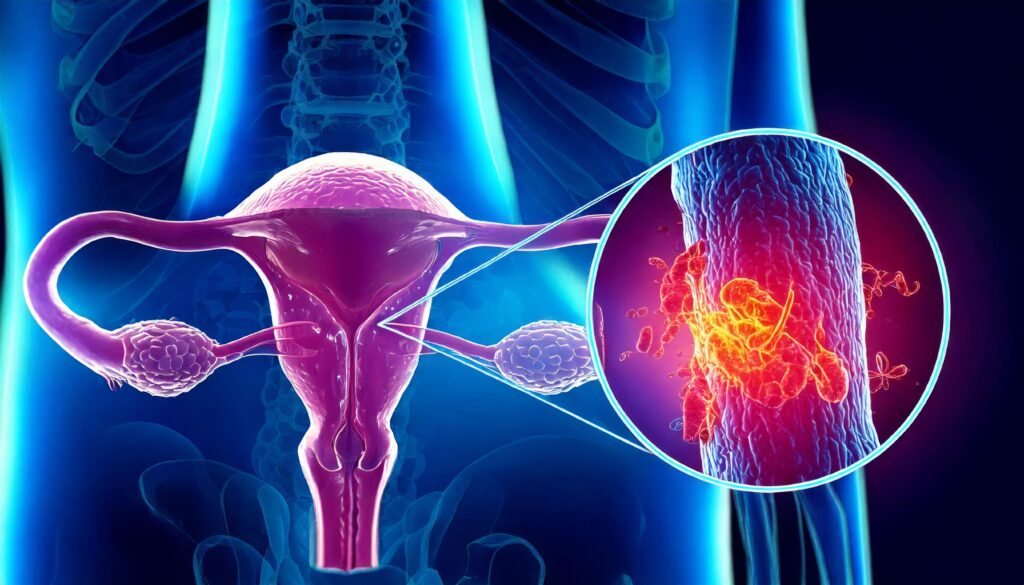
Endometrial cancer (EC) is the most common female reproductive tract cancer in the United States, and is one of few cancers with increasing incidence and mortality. In some communities, uterine cancer is now more common than breast cancer and kills more people than lung cancer (Timoteo-Liaina et al 2020). Among guideline-forming organizations, the prevailing official recommendation is to do nothing to address this reality. There is no current recommendation on screening for EC in asymptomatic patients.
Our goal is to raise awareness about the prevalence of EC, deliver vulnerable patients the care they need, and challenge our colleagues to do the same. Efforts are underway to use primary care outreach and access to identify patients with risk factors that predispose them to endometrial cancer, thus promoting early detection and intervention. Some risk factors for endometrial cancer are obesity and conditions like Polycystic Ovary Syndrome and Metabolic Syndrome, along with age, diabetes, Lynch Syndrome, and the use of certain medications like tamoxifen.
Continued education for primary care providers is needed to heighten the awareness of risk factors and to encourage timely referrals. Patient screening is obtaining the pertinent history by asking the right questions and obtaining an endometrial biopsy when suspicion warrants. Often women who are diagnosed with EC experience delayed recognition of symptoms, lack of access, delayed referral, and inadequate treatments.
Our group has undertaken research to change this by demonstrating repeatedly that uterine cancer should be and can be screened, if not in the general population, then in at least those communities with a disproportionate burden of disease (Del Priore et al 2019). Community outreach and awareness programs need to stress the importance of gynecologic evaluations for abnormal bleeding, and/or irregular and unexplained missed periods. Continued implementation of these programs and/or enhancement of policies are paramount to the reduction of endometrial cancer disparities and improvement in the overall outcome of women at risk for this significant disease.
Previous historical reports describe low mortality and typical early-stage uterine cancer that is easily detected due to abnormal uterine bleeding prompting timely evaluation. Today, access to healthcare is being denied to many communities at the same time that uterine cancer is rising more than most other cancers (Leonis et al 2025). This and a variety of other issues have transformed the classic early detected, easily cured uterine cancer into the number one cancer killer for some communities.
The incidence of uterine cancer is also shifting to earlier ages at least partly due to epidemic obesity. Because more years of life are a risk, screening may have a larger impact than other screening recommendations currently considered standard of care. The number needed to treat at an earlier screening age may be larger, but the total number of quality life years saved may be greater than in older populations with a lower number needed to screen and detect cancer. Regardless, when compared decade to decade in some communities, the incidence and prevalence of uterine cancer is greater than breast or prostate cancer (Scott et al 2019).
Previous objections to screening have cited the low positive predictive value of sonograms (Del Priore 2000). However, that was in populations with low incidence e.g. 1/10,000. Even previously considered high risk groups e.g., breast cancer patients on tamoxifen, have an incidence too low to warrant screening i.e. 1/1000. Also paradoxically, uterine cancer on tamoxifen is often detected early with better prognosis due to a high degree of suspicion. These criticisms are no longer valid, as improved, no-cost detection formulas can identify cohorts with actionable pathology (cancer and its precursor lesions) at a prevalence of up to 1/5 women (Chavez et al 2023). The number needed to treat clearly justifies going to endometrial biopsy immediately, especially in situations with limitations on access. Colon cancer screening with a colonoscopy is not as favorable on cost, number needed to treat, complications, pain or any parameter compared to uterine cancer screening even with an office biopsy.
Relative incidence of EC is higher than that for many cancers for which we already screen, including cervical cancer and other cancers with active screening research programs, such as ovarian cancer. EC does not have the same controversies that exist around prostate and breast cancer screening (screening may do more harm than good in the subsets of patients with those cancers whose disease has a long indolent natural history).
Overall, as risk factors for EC become more prevalent, and the affected population grows older with increasing related comorbidities, the need becomes more urgent for a thorough, rigorous, and scientific approach to determining who, when and how to screen. It will also be important to consider relative costs and benefits associated with these strategies. Changes in the overall health of our society have now made it imperative for all stakeholders to reconsider screening for EC.
Additional Credits:
Timoteo-Liaina I, Khozaim K, Chen YA, Buenconsejo-Lum L, Arslan AA, Matthews R, Del Priore G. The rising relative and absolute incidence of uterine cancer in specific populations. Int J Gynaecol Obstet. 2021 May;153(2):330-334. doi: 10.1002/ijgo.13130. Epub 2020 Apr 27. PMID: 32112712; PMCID: PMC8939081.
Del Priore G, Matthews R. Will screening for endometrial cancer soon be routine? Contemporary OB/GYN. 2019 Aug;64(08)
Del Priore G, MD, Hamed KK, Chen, YJ, Timoteo-Liaina I, Matthews RPW, Buenconsejo-Lum, L. Is screening for uterine cancers an opportunity to reduce cancer s burden among populations with disparities? Obstet Gynecol. May 2019; 133: 84S
Leonis R, Chavez T, Caldwell A, Del Priore G, Matthews R, Franklin C. Inequities in Surgical Access for Women With Endometrial Cancer in the United States: Opportunities for Surgical Justice. Am Surg. 2025 May;91(5):746-750. doi: 10.1177/00031348251318376. Epub 2025 Feb 9. PMID: 39924688.
Scott OW, Tin Tin S, Bigby SM, Elwood JM. Rapid increase in endometrial cancer incidence and ethnic differences in New Zealand. Cancer Causes Control. 2019 Feb;30(2):121-127.
Chavez TF, Snyder R, Lee RK, Mosunjac M, Del Priore G. Rising endometrial cancer rates and potential for screening. Int J Gynecol Cancer. 2023 Sep 4;33(9):1487. doi: 10.1136/ijgc-2023-004701. PMID: 37419513.

Roland Matthews, MD
Dr. Matthews is a Georgia CORE Board Chair and Associate Professor at Morehouse School of Medicine (MSM). Dr. Matthews chairs the Department of Obstetrics and Gynecology at MSM and is a gynecologic oncologist and attending physician at Grady Memorial Hospital. He is an executive committee member of the SUNY Stony Brook School of Medicine Health Science Center in Brooklyn, New York, where he received his Doctor of Medicine. He is also a Georgia Cancer Coalition Distinguished Cancer Scholar, investigating the role of prohibition in cervical cancer.

Giuseppe Del Priore, MD
Dr. Del Priore has been an endowed tenured distinguished professor and on faculty at Weill Cornell Medicine, New York University School of Medicine. Dr. Del Priore completed his MPH degree with Distinction from the State University of New York, Downstate; his BA, magna cum laude, at The City University of New York.


