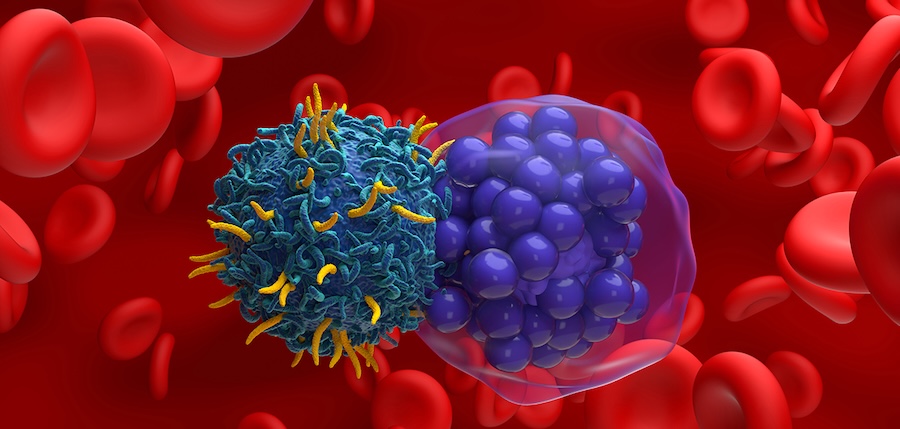
The Northside Hospital Cancer Institute announced its Blood & Marrow Transplant (BMT), Leukemia and Immunotherapy Clinical Research Program has enrolled the first mantle cell lymphoma (MCL) patient nationwide in an early-phase clinical trial evaluating novel dual-target CAR T-cell therapies for patients with relapsed or refractory B-cell lymphoma.
The study, titled “A Phase 1/2 Open-Label, Multicenter Study Evaluating the Safety and Efficacy of KITE-363 or KITE-753, utilizing Kite’s DuoCore™ construct, two independent CARs working synergistically, in Subjects with Relapsed and/or Refractory B-cell Lymphoma (NCT04989803),” is sponsored by Kite, A Gilead Company. The trial is designed to evaluate the safety and efficacy of investigational autologous CAR T-cell therapies KITE-363 and KITE-753, which target both CD19 and CD20 antigens.
Northside Hospital is the first site in the nation to enroll a patient in the mantle cell lymphoma cohort of this study, underscoring its leadership in advancing access to early-phase, cutting-edge immunotherapy trials outside of a traditional academic medical center setting.
MCL is an aggressive, difficult-to-treat lymphoma, and many patients relapse after existing treatments, including CAR T-cell therapy. This new generation cell therapy is designed to reduce tumor resistance by targeting two antigens instead of just one.
“While CD19-directed CAR T-cell therapy is the standard of care, disease relapse following treatment continues to be a major cause of treatment failure,” said Dr. Asad Bashey, medical director for Northside’s Blood & Marrow Transplant, Leukemia and Immunotherapy Clinical Research Program.
“Dual targeting of both CD19 and CD20 antigens may help overcome tumor resistance and improve long-term outcomes,” Bashey added. “Our participation in this trial — and enrolling the first MCL patient nationwide — is an important step forward in expanding access to next-generation therapies and demonstrates the availability of pioneering novel therapy clinical trials at Northside.”
The initial investigational therapy explored in Phase 1, KITE-363, is a bicistronic autologous CAR T-cell product engineered to express two independent chimeric antigen receptors:
- One targeting CD19 with a CD28 costimulatory domain
- One targeting CD20 with a 4-1BB costimulatory domain
This dual-targeting approach is designed to enhance both efficacy and safety by combining complementary signaling pathways.
A next-generation version of the therapy, KITE-753, is also being studied in Phase 1 and Phase 2, with faster manufacturing and a significantly lower cell dose.
KITE-753’s rapid manufacturing process produces a less differentiated, more “juvenile” CAR T-cell population, enabling treatment at a dose of approximately 200,000 CAR T-cells versus 2 million cells used in earlier CAR T-cell therapies.
This approach may translate into improved efficacy and safety outcomes, as well as faster time from cell collection to infusion, which may facilitate CAR T use in broader community and outpatient settings.


