There are currently over 100,000 patients on the organ transplant waitlist in the United States, with an estimated 17 deaths occurring every day as patients await suitable life-saving organs.
For decades, the demand for organs in transplantation has outpaced the availability of organs. While there have been significant improvements in organ preservation techniques that have led to the increased utilization of donors, the challenges of donor-recipient matching and providing opportunities for all patients on organ waitlists have motivated the transplant community to pursue additional avenues for expanding the supply of potential organs for transplantation.
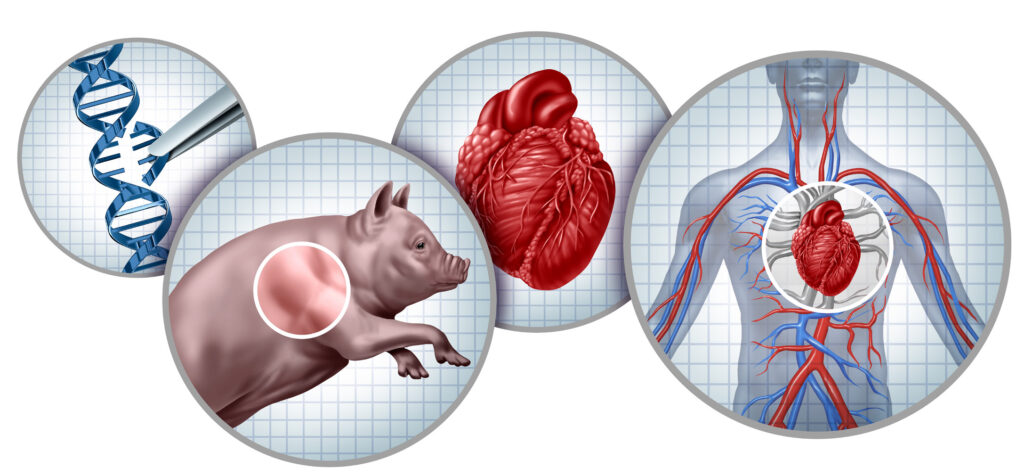
One avenue that was once thought to be a pipe dream of science fiction has recently found footing in clinical translation – xenotransplantation. Xenotransplantation is the practice of taking the organs from one species and transplanting them into another, in this case from genetically modified pig donors into human recipients. While the concept of xenotransplantation has been described as early as the 17th century, the medical community has never been so close to the clinical translation of xenotransplantation as it is today.
Historical Overview
In 1667, the French physician Jean-Baptiste Denys performed the first recorded animal-human blood transfusion, taking the blood from a sheep and transfusing it to a human patient. In the centuries since, there have been various attempts at solid organ xenotransplantation, ranging from primate kidneys to hearts.
One significant milestone occurred in 1963 when Dr. Keith Reemtsma transplanted chimpanzee kidneys into 13 human patients suffering from uremic kidney failure Ð surprisingly, one of his patients went on to survive for 9 months, establishing the potential viability of xenotransplantation in clinical practice.
Dr. Thomas Starzl, considered by many to be the pioneer of liver transplantation, also performed his own series of baboon kidney transplants to human patients, but like previous attempts, he was met with limited success and early episodes of hyperacute antibody-mediated rejection with resultant graft loss.
Then in 1984, xenotransplantation entered the public eye when a high-profile case of an infant born with hypoplastic left heart syndrome at Loma Linda University underwent xenotransplantation with a baboon heart xenograft by Dr. Leonard Bailey.
This case of “Baby Fae”, who went on to survive for 21 days, split the medical community and the public on the ethical considerations of xenotransplantation and highlighted the immunological challenges inherent in cross-species transplantation.
Scientific Advances
In the modern era since the early experimental attempts at xenotransplantation, clinicians and scientists alike have discovered that rather than primates, pigs actually serve as the ideal potential donors for xenotransplantation due to their physiological similarities. Furthermore, the identification of an aGal protein expressed on the surface of pig organs explained the hyperacute rejection seen with early attempts at clinical xenotransplantation; humans have preformed antibodies against this aGal protein. Therefore, scientists discovered that silencing the expression of this protein allowed for the successful xenotransplantation of aGal knockout pig organs to humans without immediate antibody-mediated hyperacute injury and rejection.
However, it wasn’t until advancements in genetic engineering and the advent of modern techniques such as CRISPR-Cas9 revolutionized the ability of scientists to rapidly modify potential pig organs for translational research and eventual clinical use. This in combination with advanced understanding in next-generation immunosuppression medications allowed for scientists to take xenotransplantation from a fringe research topic to a truly translational effort.
Researchers discovered that focusing on immunosuppression regiments based around a costimulation blockade such as belatacept and aCD154 rather than conventional immunosuppression drugs allowed for prolonged survival when utilizing genetically modified pig organs lacking aGal and expressing complement decay-accelerating factor to protect organs further from antibody-mediated injury.
A breakthrough came in 2017 when researchers at Emory published on the longest-surviving pig-to-primate renal xenotransplant of 499 days1, which up until that point nearly tripled the longest reported survival to date. This was soon followed by several other research groups around the country finding similar success with novel immunosuppression therapies and more advanced genetic modifications in pig donors.
Attempts also extended to liver xenotransplantation, although efforts to transplant pig livers across species were largely unsuccessful, with rapid coagulation dysregulation and platelet consumption leading to rapid death. However, with landmark advancements in heart and renal xenotransplantation in preclinical large animal models, the hope of translating the basic science discoveries around xenotransplantation into clinical reality gained traction.
Excitement in the realm of xenotransplantation quickly extended from academia to industry. As more genetic deletions and transgenic targets were identified that could afford survival benefit to xenografts, the demand for faster and greater genetic edits in porcine donors drew the interest of two companies that have become industry leaders in the advancement of xenotransplantation Ð Revivicor (United Therapeutics) and eGenesis. Both of these companies have developed state-of-the-art pathogen-free pig breeding and genetic editing facilities that have supplied the pigs for first-in-human clinical attempts for xenotransplantation in partnership with transplant institutions in the United States.
Clinical Milestones and Modern Xenotransplantation
In 2022, the first pig heart xenotransplant was performed using a genetically modified pig heart into a human patient at the University of Maryland.2 The pig heart was procured from a 10-gene edited (10GE) pig designed by Revivicor and was transplanted into a 57-year-old man with end-stage nonischemic cardiomyopathy who was deemed not a candidate for heart allotransplantation by the transplant team at the University of Maryland. After careful counseling, the patient underwent the xenotransplantation; the pig heart functioned initially for two months before the patient ultimately died from complications from the index operation.
However, clinicians at Maryland noted that there were no signs of rejection on biopsy or decline in xenograft LVEF function prior to the patient’s clinical decline. The University of Maryland soon performed a second pig heart xenotransplantation the next year3; however, this second xenograft was noted to have significant antibody-mediated rejection despite careful selection of a recipient with low pre-formed antibody titers and using the same 10-gene edited pig heart from Revivicor. These experiences highlight the need for further research to understand the secondary mechanisms of xenograft injury beyond antibody-mediated rejection.
In addition to first-in-human heart xenotransplantation, recent efforts in kidney xenotransplantation have been undertaken by transplant surgeons at Massachusetts General Hospital and New York University. In 2024, surgeons at the Massachusetts General Hospital transplanted a genetically modified pig kidney obtained from eGenesis with 69 genomic edits into a 62-year-old patient with end-stage renal disease.4 In this experience, the pig kidney functioned immediately, and, even in the face of early rejection, clinicians were able to treat the rejection early and stabilize the function of the xenograft.
The patient was off dialysis and ultimately discharged from the hospital on postoperative day 18. After a clinic visit on POD 51, the patient was noted to have good xenograft function and normal ultrasounds of the pig kidney; however that evening, the patient reportedly had a sudden clinical decompensation with respiratory distress and subsequent death.
The post-mortem autopsy demonstrated diffuse LV fibrosis from diabetic and ischemic cardiomyopathy. Clinicians from Massachusetts General Hospital communicated that they felt this mortality was unrelated to the xenotransplant, but rather due to medical comorbidities from the patient’s long-standing end-stage renal disease. Then later that year, surgeons at New York University performed two kidney xenotransplants. The first was performed in a recipient who had both heart and kidney failure.
Surgeons first implanted a left ventricular assist device (LVAD) followed by a genetically modified pig kidney in partnership with Revivicor using the same 10-gene edited pig used by the University of Maryland for its heart xenotransplants. Despite the LVAD placement, the clinicians were unable to wean the patient off life-sustaining vasopressors, and the xenotransplanted kidney failed to function and was ultimately removed.
In November of 2024, New York University again made the news by performing its first pig kidney xenotransplant with a Revivicor 10GE pig in a 53-year-old woman from Alabama who had been on dialysis for 8 years. The patient did well, the xenotransplanted kidney performed immediately, and the patient was discharged on postoperative day 11.5
This kidney functioned effectively for several months Ð the longest reported survival of a xenotransplanted pig kidney in the modern era of 130 days; however in April of 2025, the pig kidney was removed due to rejection episodes that occurred after her immunosuppression had to be reduced for opportunistic infection.
Future Directions
The rapid growth and interest in xenotransplantation has launched a once-fringe experimental procedure into the forefront of clinical development. With buy-in from researchers, clinical transplant institutions willing to take on scientific challenges, and industry partners, the pace of progress in xenotransplantation has accelerated. Plus, increased interest from key stakeholders and advancement in gene editing technology has made engineering of these pig donors cheaper and more available. In fact, recent FDA approval for the proprietary genetically modified pig from Revivicor has led to enrollment for first in-human clinical trials for kidney xenotransplantation.
While this has understandably continued to garner excitement from the medical community, important questions remain for the ultimate safe implementation of clinical xenotransplantation. The FDA has noted in a consensus statement that xenotransplantation should be limited to patients with serious or life-threatening disease for whom adequately safe and effective alternative therapies are not available. Furthermore, they state that these patients should be significantly disadvantaged or completely excluded from being offered a human organ.
But if different transplant programs have varying criteria for listing and practice patterns for human organ acceptance, how can we be sure that a patient who would be deemed significantly disadvantaged at one center wouldn’t be offered a human kidney at another center with more comfort performing high-risk transplants? Furthermore, the ethical questions surrounding xenotransplantation are also sure to create further policy concerns. The questions surrounding infectious disease transmissions from pig donors to human recipients remain at the forefront of many minds, especially in the era of global pandemic risk. And while there have been many studies about porcine endogenous retroviruses, the potential transmissibility or reactivation of opportunistic infection in the face of increased immunosuppression necessary for xenotransplantation will need to be weighed.
Finally, it will be very important to consider the publics perception of the clinical implementation of organ xenotransplantation. Rather than repeat the mistakes of historic one-off attempts of experimental xenotransplantation that led to public outcry and mistrust, the modern era of xenotransplantation will benefit from careful clinical trial design, collaboration among multiple transplant centers and researchers, and transparency.
Dr. Norm Shumway once pessimistically stated, Xenotransplantation is the future of transplantation, and it always will be. But the advent of clinical xenotransplantation seems more achievable in our lifetime than ever.
References
1. Kim, S.C., et al. Long-term survival of pig-to-rhesus macaque renal xenografts is dependent on CD4 T cell depletion. Am J Transplant 19, 2174-2185 (2019).
2. Griffith, B.P., et al. Genetically Modified Porcine-to-Human Cardiac Xenotransplantation. N Engl J Med 387, 35-44 (2022).
3. Griffith, B.P., et al. Transplantation of a genetically modified porcine heart into a live human. Nat Med 31, 589-598 (2025).
4. Kawai, T., et al. Xenotransplantation of a Porcine Kidney for End-Stage Kidney Disease. N Engl J Med 392, 1933-1940 (2025).
5. https://apnews.com/article/pig-kidney-transplant-xenotransplant-nyu-alabama-021afcc9697a0a490c0d0726482515b4.
6. https://ir.unither.com/press-releases/2025/02-03-2025-120011819.
 Steven C. Kim, MD
Dr. Kim is an Assistant Professor in the Division of Transplantation at Emory University. He specializes in liver transplantation and hepatobiliary surgery. He also leads a translational immunology lab focused on xenotransplantation and immune tolerance. Dr. Kim has received multiple awards for clinical and research excellence, including the Douglas A. Murray Award. His work is funded by the NIH and leading national and international transplant organizations.


